That which in the late Lacan is called jouissance of meaning is an experiential kind of knowing, constructed in the process of psychoanalysis or in a self-reflective, questioning and skeptical life. It’s localised in the area where symbolic and imaginary intersect, according, that is, to the Lacanian topological way of thinking of psychic structure and the end of analysis (see figure 2). In my Prismatic Heresy, this becomes another ribbon, coloured green. The 7-in-1 of the spectrum provides a way of thinking the work that is done by artistic practice, separating out differently the symbolic and the imaginary, as Lacan argues was done by Joyce (Lacan 2016). Thus, for example, in Prismatic Heresy 3 the participant says, “I’ve mimicked martial arts. I’ve done my own style of martial arts since I was 8.” To this extent I’m Millerian: whether or not there is a generalised sinthome, there is a generalised play and artistic practice.
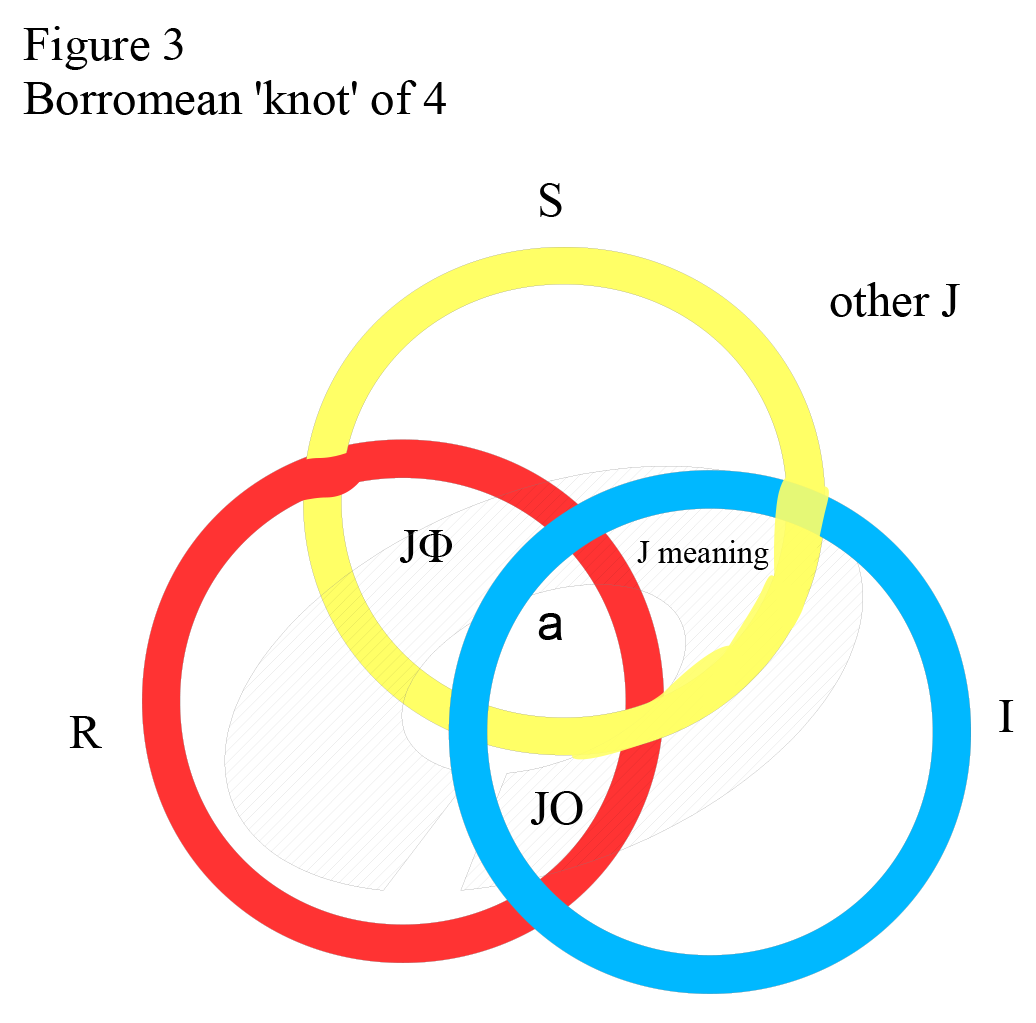
In subjective topology, the symptom is thought of as another loop (see figure 3). It moves and transforms, and in doing so, enables us to conceptualise the ways that the loops of RSI transform within the relations configured by their topology.
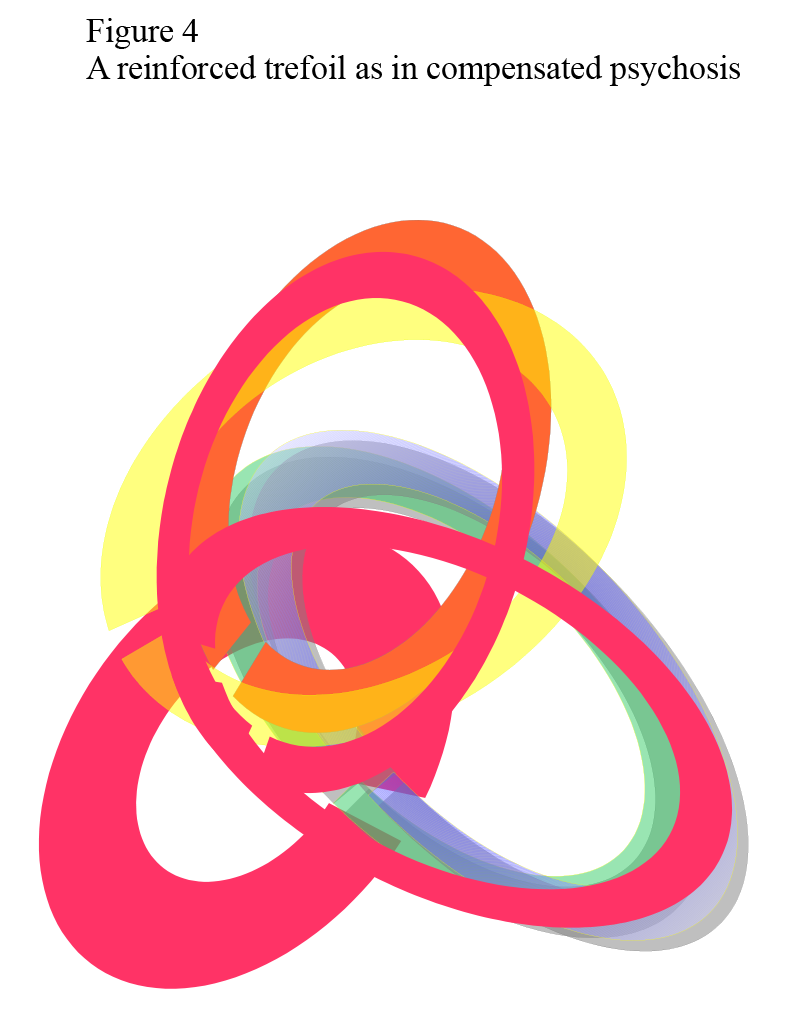
This notion, that the loops of RSI transform but still keep their topological relations, is the way that Lacanian subjective topology addresses the question of the end of analysis. The question of transformations within the constraints of topology is also central to Bion’s work, but, in Bion’s case, it has to do with the huge varieties of alpha function, from art to science (all of which are given positions in his ‘grid’). The Lacanian arguments are illuminated by turning to the question of work with persons living with psychosis. According to a topological way of thinking, the structure of a psychotic’s psyche is less clearly delineated. In terms of the three suggested topologies (Freud’s first topology, conscious, subconscious, and unconscious, Freud’s second topology, ego, superego, and id, and Lacan’s third topology, real, symbolic, and imaginary), we might say, of a psychotic patient, that he or she doesn’t repress; doesn’t have a strong ego; or lives too much in the real. Conceptualising a psychotic structure as a coloured trefoil knot allows us to conceive of the analytic work as providing a way for RSI to stabilise, to separate (see figure 4).