So, what is this work: science? (At another conference, a colleague said, “Maybe I’ll colour code my discourse analysis, too”). Art? (For example, the framer said, “I think a white box frame will work well, as it’s conceptual art”). Is it ‘witnessing’, which, as theorists and psychoanalysts from Ranjana Khanna (2003) to Jessica Benjamin (2018) and Thomas Ogden (2004) argue, is a mode of relating that poses an alternative to a Hegelian Master-Slave dialectic? As Merleau-Ponty (1969) theorises, witnessing opens up a space for a third.2 ((For Merleau-Ponty, the third is the third person, the he or she; we might also add the non-binary singular third person, ‘they’. For Ogden and Benjamin, it is a third constructed relationally in the therapeutic space; Ogden’s ‘third’ is more of a field theory and Benjamin’s ‘third’ more an attachment-theory based philosophical position. Khanna’s argument is Fanonian, constructing a postcolonial critique of psychoanalysis and a symptomatic reading of colonialism in terms of melancholia; a genealogical approach but also a witnessing. It would be interesting to unpack the relations between genealogical, Foucauldian work, with its critique of oppositions between subject and object and ‘thirdness’. I discuss Merleau- Ponty’s argument and its implication for psychoanalytic practice further in my unpublished paper Working with Psychosis, Lacan and Merleau- Ponty.))
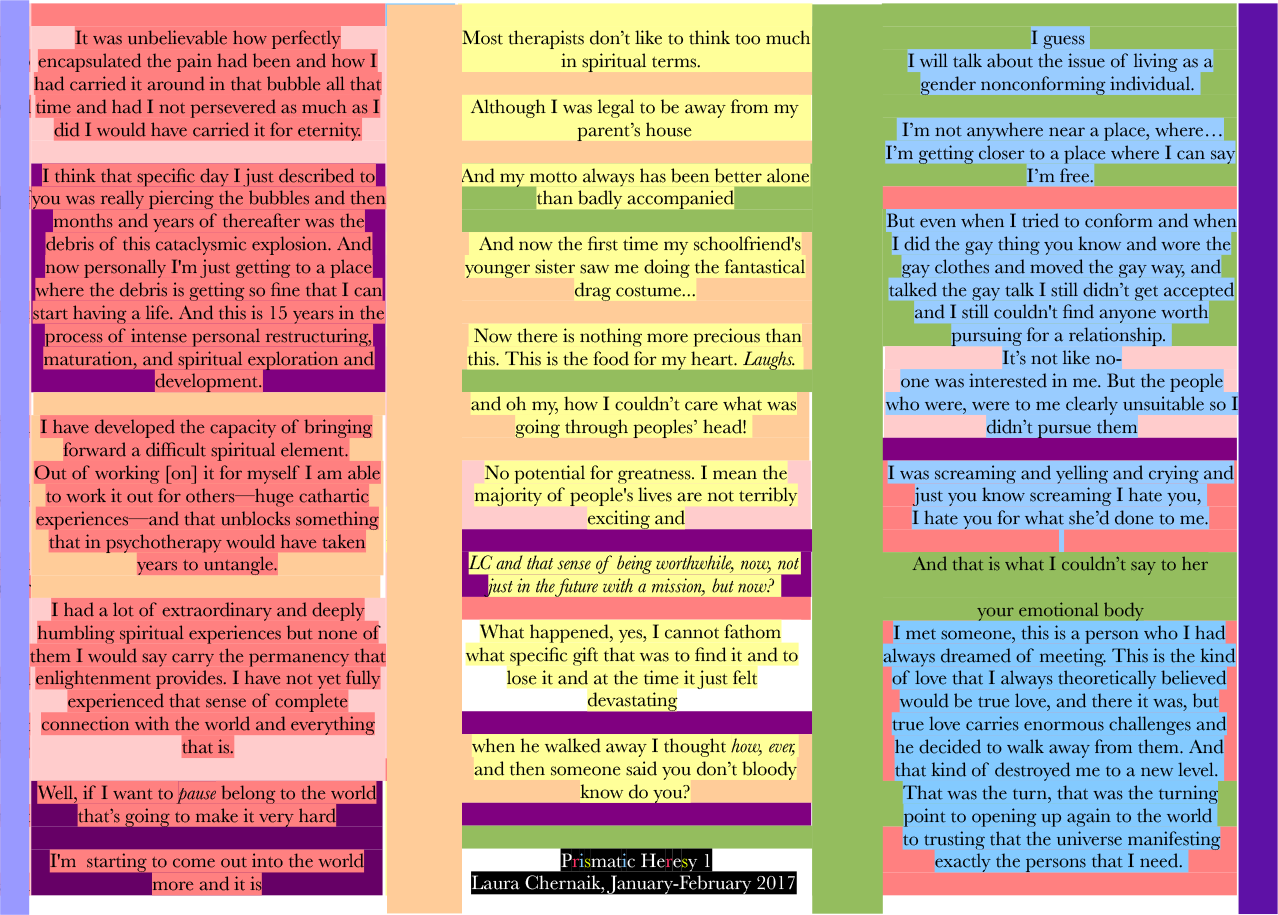
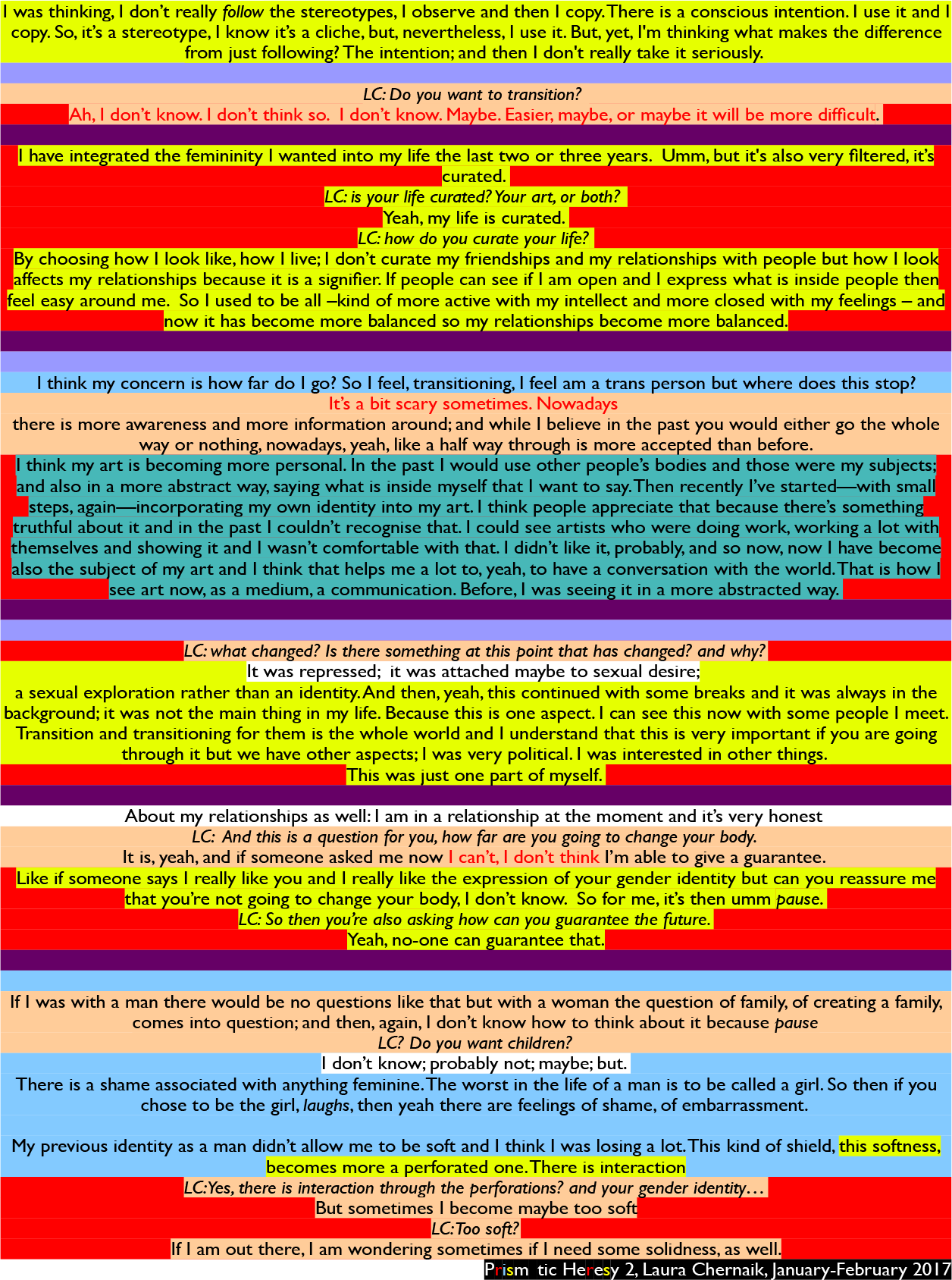
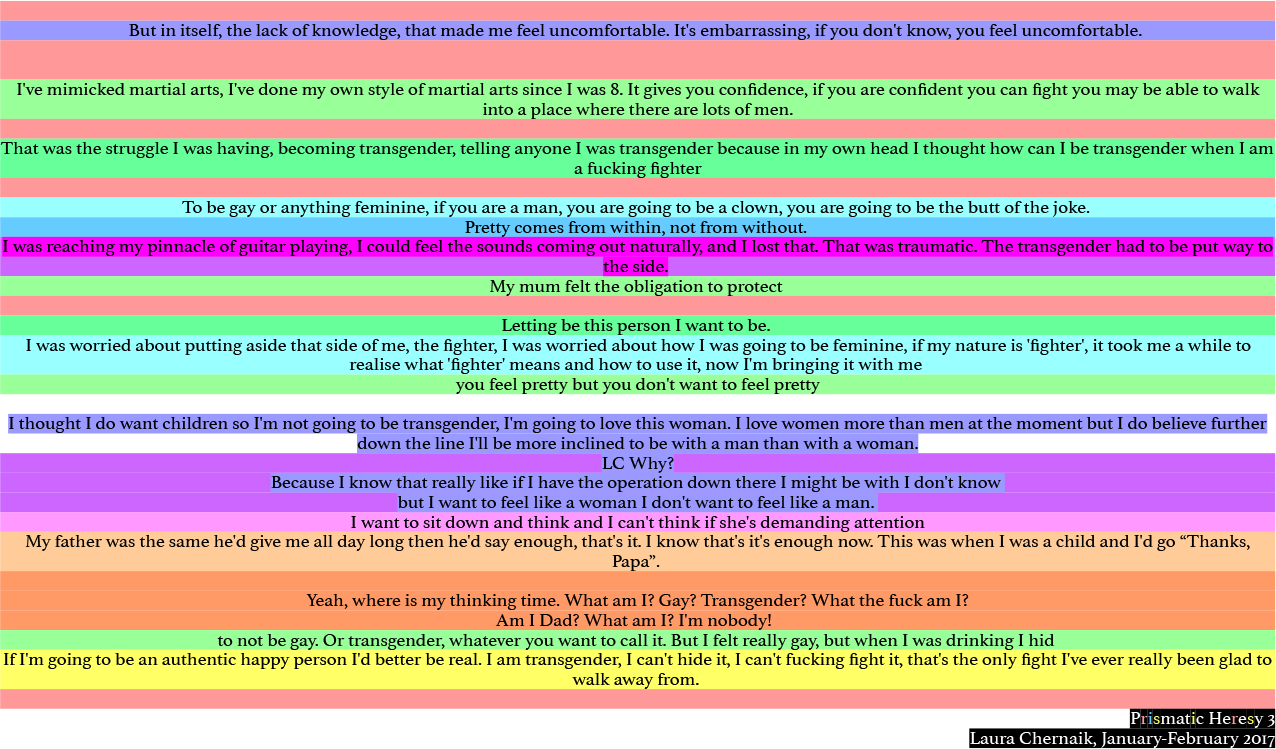
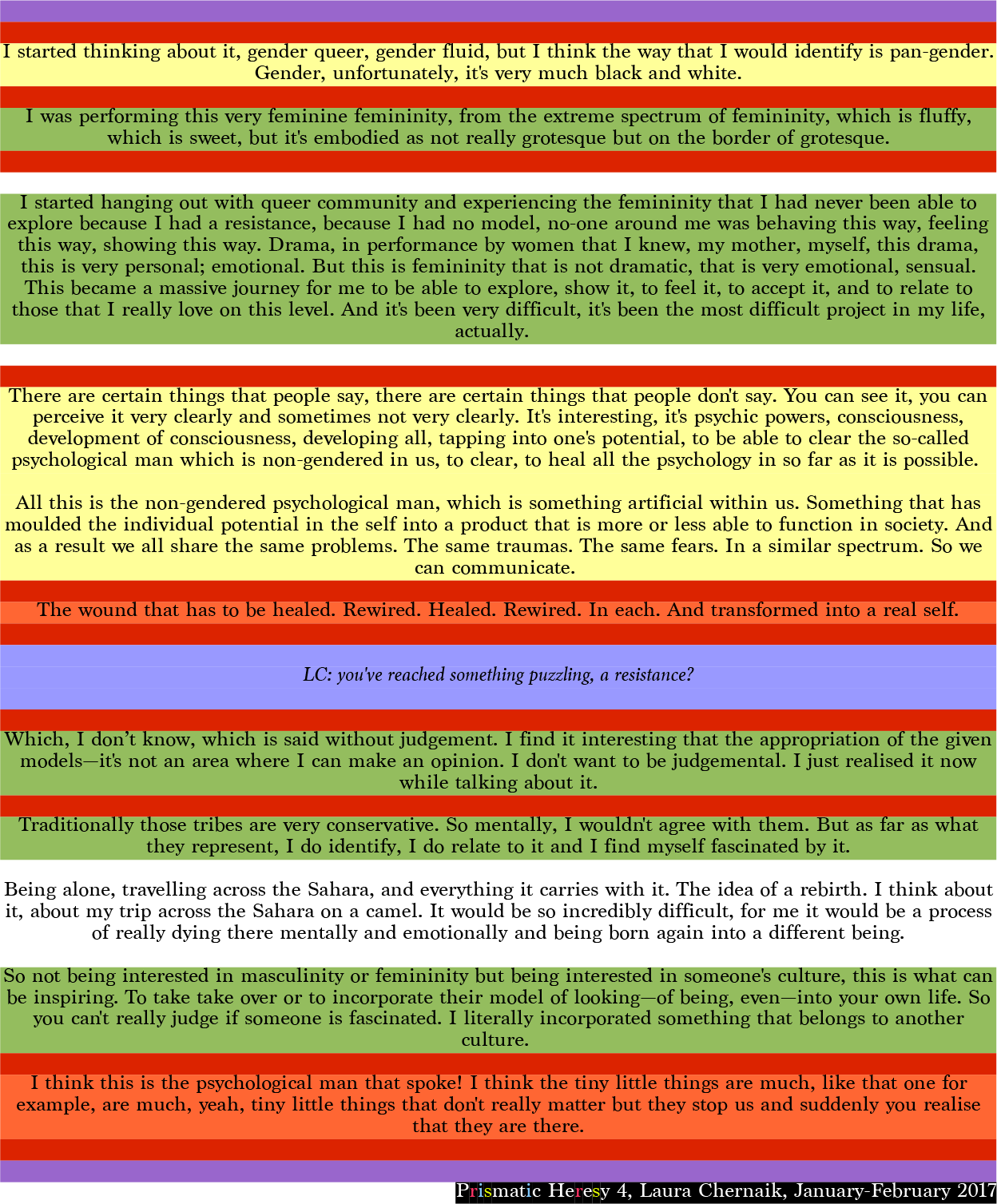
A prism refracts white light into a spectrum, the 7 colours of a rainbow, hence the first word of the title, Prismatic Heresy. White light runs around and within the colours and words in all four Prismatic Heresies: for example, in Prismatic Heresy 2, “I don’t know, probably not; maybe; but”, good enough words for an ostentive definition of the psychoanalytical field. All four works display the red, yellow, and blue of what Lacan calls the 3-in-1 of Real, Symbolic, and Imaginary, RSI; pronounced ‘hérésie’. I think of psychic structure (and thus differential diagnosis) within the context of what Badiou calls ‘worlding’ (2005; 2009). The intersubjective field, whether psychoanalytic transference or that called into being when a visitor to an art gallery engages with a work of art, is an instantiation of this, it is what Spinoza and Deleuze call an actualisation. Psychic structure, whether Lacan’s RSI or Freud’s first or second topologies, is a hypostatisation. Prismatic Heresy refracts the white light of the field into 7-in-1, not just 3-in-1.
In Prismatic Heresy, the analyst’s speech is indigo. A silent pause or cut, violet. Orange is my colour for what Bion calls alpha function, that is, for my perception that the ‘participants’ (as these 4 people were not my analysands) were thinking-and-feeling in terms of presence-and-absence. I coloured artistic practise green; and it’s also play, if we take Winnicott’s point that art is play for grown-ups. In one session, I heard how that person was scaffolded by artistic practise and alpha function, and I arranged the words synchronically, so the structure—the scaffolding— would manifest visually. The work, thus, is also about what Aulagnier (2001) calls, drawing on Heidegger, the violence of interpretation. The synchronic frame did violence to the profound impact of the oral history told by this subject. Also, while green colours two thirds of this image, it was in subsequent events that I was privileged to learn more about their artistic practise. ‘Subsequent events’; that is, diachrony. Time’s arrow goes down, in the three other images.