
by Admin General | Nov 10, 2025
The Site for Contemporary Psychoanalysis’s French Psychoanalysis in Translation seminar series responds to the steady increase in interest in French psychoanalysis in translation over recent years. English readers are now much better situated to appreciate the breadth and depth of French psychoanalytic thinking thanks to the continued efforts of publishers and translators to bring more classic and contemporary texts to an Anglophone audience. In response to this, the Site is inviting translators to discuss their work and that of the psychoanalytic authors whose texts they have translated.
The first seminar in the series will focus on the work of Pierre Fédida and celebrate the recent publication of his selected essays, Psychopathologies of Living (Routledge, 2025), in English. Translators Patrick Ffrench and Nigel Saint will be in conversation with Site member Ana Minozzo, discussing the important place of Fédida in French academic psychoanalysis and the challenges of rendering his ideas into English.
Please Note: This event is going to be recorded, and the recording will be made available to attendees for FREE.

by Admin General | Oct 25, 2025
About this event
The most tragic form of loss isn’t the loss of security; it’s the loss of the capacity to imagine that things could be different.
– Ernst Bloch
Utopia promises us an ideal paradox consisting of a limit and an opening: a limit to our suffering and frustrations and an open road to the unimpeded pursuit of our desires. It embodies an unconscious dialectic—a paradoxical symbol standing both as a boundary and as an opening. Utopia functions as a projection of an ideal state where suffering and frustration are contained within a symbolic limit, yet simultaneously, it beckons the subject toward an unbounded horizon of desire’s fulfilment.
The Greek etymology — οὐ τόπος, “no-place”, coined by Sir Thomas More — offers a Lacanian meditation on the allure and treachery of the unattainable. It hints at an impossible desire for a perfect state beyond language and reality, a dead end that may serve as a phantasmatic anchor rather than a genuine horizon. And yet, 500 years after the word was created, the hope for limitlessness and resolution is still ever present, we persistently cling to an elusive longing for an unconditioned plenitude — an eternal resolution that perpetually slips just beyond the grasp of symbolization.
This collection of dialogues — propelled by thinkers engaged in psychoanalytic, philosophical, and critical inquiry — invites us to question the function of hope and utopia within the psychic economy. What revelations can these domains offer about the role of hope in the analytic process? How does utopia manifest in the clinical setting? Are we inclined to relinquish hope, or does it serve as a vital structuring force? If hope persists, how can it be harnessed therapeutically? Moreover, does hope belong solely to the realm of optimal illusions and dangerous fantasies, akin to Pandora’s box, or can it be transformed into a sustained, constructive act within the matrix of the analytic encounter?
Speakers
(In order of speaker)
Richard Gilman-Opalsky
Jon Greenaway
Billie Cashmore
Alexander Stoffel
Jim O’Neill
Foluke Taylor
Anouchka Grose
Programme
10.00-10.30: Registration and Coffee
10.30-10.40: Welcome
10.40-11.30: Keynote Speaker
Richard Gilman-Opalsky – Imaginary Power, Real Horizons: The Political and Psychological Necessity of Utopianism
11.30-13.00: Panel 1:
One or Many Utopias: Marx, Bloch, Materialism and Desire
Jon Greenaway – Thoughts Out of Season: On Inappropriate Utopia and the Heritage of Our Time.
Billie Cashmore – Utopia Must Not Be A Theological Category
Alexander Stoffel – Desire and Capitalist Contradiction: Towards a Non-Functionalist Account of Desire
13.00-14.15: Lunch
14.15-15.45: Panel 2:
The Laboratory for Feminist Listening: Feminist Listening as Worlds in the Making
15.45-16.15: Break
16.15-17.45: Panel 3:
Utopia and the Clinic
Jim O’Neill – Utopia: “Heroic Failure”
Foluke Taylor – TherapeutiX: Sketches from a Black Feminist Playground
Anouchka Grose – Come Back Marcuse, All is Forgiven
17.45-18.00: Closing Thoughts
18.00: Reception
Concessionary rates are available for non-Site students, trainees and NHS employees.
If the ticket price is a barrier to access and the above does not apply to you, please contact the Site Administrator, Jane Nairne, at jane.nairne@the-site.org.uk.

by Admin General | Oct 8, 2025
Biography
Adam Phillips is a psychoanalyst and an Honorary Visiting Professor in the Department of English and Related Literature at York University. He was formerly a Principal Child Psychotherapist at Charing Cross Hospital, London. He is the General Editor of the Penguin Freud, and author of a host of books, essays and studies from On Kissing, Tickling and Being Bored to Becoming Freud: The Making of a Psychoanalyst and most recently In Writing, Unforbidden Pleasures, On Wanting to Change, On Getting Better and On Giving Up.
If you need any assistance, please contact the Site Administrator, Jane Nairne, at jane.nairne@the-site.org.uk.
by Admin General | May 17, 2025
‘On Resistance’ – Site member Adam Phillips will be speaking “On Resistance”
Biography
Adam Phillips is a psychoanalyst and an Honorary Visiting Professor in the Department of English and Related Literature at York University. He was formerly a Principal Child Psychotherapist at Charing Cross Hospital, London. He is the General Editor of the Penguin Freud, and author of a host of books, essays and studies from On Kissing, Tickling and Being Bored to Becoming Freud: The Making of a Psychoanalyst and most recently In Writing, Unforbidden Pleasures, On Wanting to Change, On Getting Better and On Giving Up.
by Admin General | Mar 1, 2025
About this event
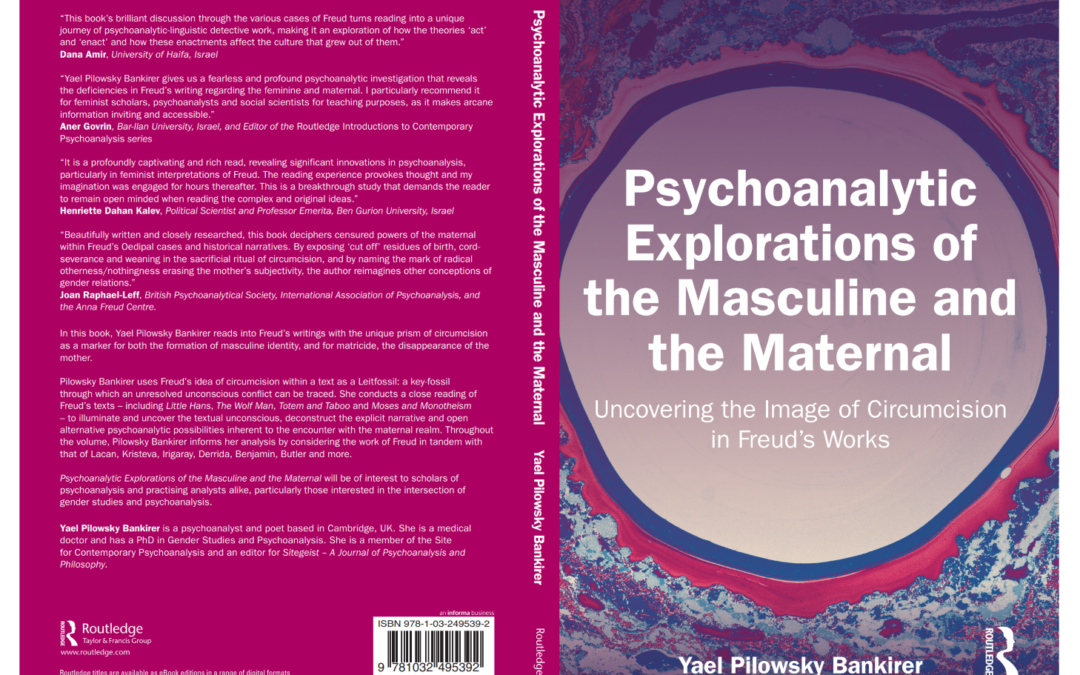
Talking about Matricide – a panel discussion following Yael Pilowsky Bankirer’s book “Psychoanalytic Explorations of the Masculine and the Maternal: Uncovering the Image of Circumcision in Freud’s Works”.
(The book will be on sale at the event)
The event will explore the concept of matricide within psychoanalysis, particularly in relation to the image of circumcision as a site for the formation of masculine identity. The speakers will respond in their presentations to one of the book chapters: “Little Hans: A Double Layered Matricide”. Through the playful story of little Hans, his fascinating conversations with his parents, and his dreams and fantasies, this book chapter depicts the way Freud repeatedly both formulates and conceals matricide as part of masculine Oedipalisation.
In her book, Psychoanalytic Explorations of the Masculine and the Maternal, Yael Pilowsky Bankirer reads into Freud’s writings with the unique prism of circumcision as a marker for both the formation of masculine identity, and for matricide, the disappearance of the mother.
Yael Pilowsky Bankirer uses Freud’s idea of circumcision within a text as a Leitfossil: a key-fossil through which an unresolved unconscious conflict can be traced. She conducts a close reading of Freud’s texts – including Little Hans, The Wolf Man, Totem and Taboo and Moses and Monotheism – to illuminate and uncover the textual unconscious, deconstruct the explicit narrative and open alternative psychoanalytic possibilities inherent to the encounter with the maternal realm. Throughout the volume, Pilowsky Bankirer informs her analysis by considering the work of Freud in tandem with that of Lacan, Kristeva, Irigaray, Derrida, Benjamin, Butler and more.
Speakers
Dr. Yael Pilowsky Bankirer is a psychoanalyst and poet based in Cambridge, UK. She is a Medical Doctor and has a PhD in Gender Studies and Psychoanalysis. She is a member of the Site for Contemporary Psychoanalysis and an editor for Sitegeist – a journal of psychoanalysis and philosophy.
Prof. Miri Rozmarin is an Associate Professor in the Gender Studies Program at Bar-Ilan University. She is also a Senior Research Fellow and the Head of the research lab “Contemporary Feminist Political Subjectivities” at the Van Leer Jerusalem Institute. Her research interests include political subjectivity, vulnerability theory, and maternal subjectivity. She has published extensively in these areas, including two books and numerous articles in leading journals. Her current research aims to explore how vulnerability is mobilized as a resource for contemporary political subjectivities.
Dana Lubinsky is a clinical psychologist and poet. Her debut poetry collection “Neither word, Nor Covenant”” (Bli Brit, Bli Mila”) published by Am Oved, 2014, for which she won the Ministry of Culture Award for Emerging Poets in Israel, explores the exclusion of women from the symbolic order, and the dialectics of feminine writing, amid women’s recent migration into written language.
Her second book, “Once Aflame” published this summer, delves into maternal subjectivity, challenging the widespread notion of motherhood as a renunciation of selfhood. In addition to her clinical practice and poetry, Dana also engages in writing essays and literary critiques that touch upon the interface between literature, gender, and psychoanalytic theory. She is a mother of three.
Rabbi Dr Tali Artman Partock teaches Judaism at the University of Cambridge and Leo Baeck College. She is also a community rabbi and training to be a psychoanalytic psychotherapist at AGIP. Her research focuses on trauma and recovery in religious communities of Late Antiquity. Mostly looking at reintegration after enslavement, prostitution and other forms of sexual violence. Some of these topics are discussed in ‘Agency Personhood and Rabbinic Law,’ forthcoming in Routledge, 2025.
